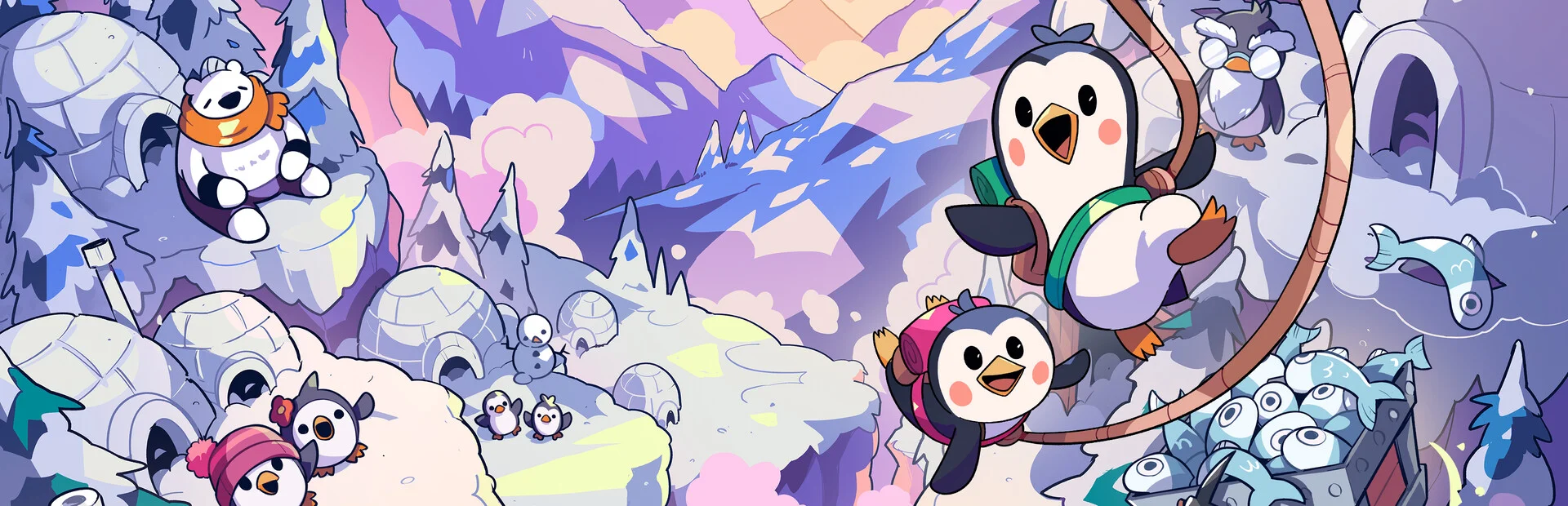
- The Bread Fred first jump requires slack rope and a verbal countdown before either player leaps.
- Jump inputs are committed: they cannot be cancelled mid-air, so timing beats speed.
- Practice on ledges: the opening mountain base is a safe zone for drill repetitions.
- Assist options can soften the learning curve while you build coordination.
- Falls reset to checkpoints, not the start — experiment freely.
Why the First Jump Feels Hard in Bread & Fred
In Bread Fred (officially Bread & Fred), two penguins are tied together by a rope and must climb a giant mountain as a pair. The first jump is where most new duos fail, because the tether physics punish unsynchronized inputs. If one player leaps while the rope is taut, the other penguin gets yanked off the ledge immediately.
The core problem is that new players treat the first jump like a standard platformer hop. It isn't. The rope is both your greatest tool and your biggest liability, and every jump must be coordinated with your partner.
Jumping without telling your partner. If the rope is taut when one penguin jumps, the rope pulls your partner off their ledge before they can react. Always keep the rope slack before any leap.
| Factor | What It Does | First-Jump Impact |
|---|---|---|
| Rope slack | Determines whether the tether pulls | Slack rope = safe jump |
| Sync timing | Both players leave ground together | Mis-timing causes yanking |
| Jump commitment | No mid-air cancellation | Wasted inputs can't be undone |
| Grab button | Clings to walls and ledges | Your recovery if a jump falls short |
| Checkpoints | Reset both players after falls | Failed first jumps cost seconds, not progress |
Step-by-Step: Landing Your First Jump
The opening section of the mountain introduces basic jumping and rope tension on gentle ledges, which makes it the ideal place to practice. Follow this sequence before attempting wider gaps.
Learn the Controls First
Each player controls movement, jump, and grab. Internalize the buttons before the first real jump, because every advanced technique in the game builds on precise, well-timed inputs from both players.
Position Both Penguins Close Together
Stand side by side on the ledge with the rope visibly slack between you. If the rope is stretched tight, one player should walk toward the other until it hangs loose.
Call a Verbal Countdown
Use "3, 2, 1, jump" in voice chat or out loud on the couch. Both characters must leave the ground at the same instant to keep the rope slack during flight.
Jump and Keep the Rope Slack
Leap together toward the target ledge. Do not grab or move mid-flight unless the jump is clearly falling short — the grab button is your safety net, not a steering wheel.
Land and Immediately Anchor
On landing, one player grabs the wall or ledge to become a stable anchor. This lets the partner recover their footing and prepares the pair for the next jump.
The mountain base features gentle ledges and low-pressure terrain. Repeat the countdown-jump-anchor cycle there five to ten times before moving on — muscle memory at the base saves hours of frustration on the cliffs.
Solo Players: The First Jump with Jeff the Rock
If you're attempting the first jump in single-player mode, the dynamic changes completely. Your rope is attached to Jeff the rock, which has weight but no movement of its own — he stays wherever you leave him.
In solo mode, your first jump is less about synchronization and more about anchor placement. Position Jeff below or behind your launch point so the rope can convert your leap into a pendulum swing rather than dragging you backward.
| Solo Scenario | Correct Setup | Result |
|---|---|---|
| Small gap | Jeff left on your starting ledge | Simple jump, rope stays slack |
| Wider gap | Jeff dropped below the lip | Pendulum swing adds distance |
| Steep wall | Jeff directly beneath the route | Rope catch prevents long falls |
| Crumbling platform | Move fast, keep Jeff behind | Avoid dragging Jeff off his perch |
Watch the rope indicator carefully: climbing too far without repositioning Jeff will drag him off his perch unintentionally and destroy your anchor point.
Common First-Jump Failures and Fixes
Most first-jump failures fall into a small number of patterns. Diagnose which one your duo is hitting and apply the matching fix.
Taut Rope Yank
- Cause: Jumping while the tether is stretched
- Fix: Close the distance until the rope hangs loose
- Recovery: Grab the wall mid-fall
Mistimed Double Jump
- Cause: No countdown, players leap separately
- Fix: Verbal "3, 2, 1, jump" count before every gap
- Recovery: Anchored partner tenses the rope to catch the other
Both Moving at Once
- Cause: Both players repositioning on a narrow ledge
- Fix: One player moves, one stays anchored
- Recovery: Reset to the last checkpoint deliberately
A fall only resets you to the last checkpoint, not the start of the mountain. If you keep failing an obstacle from a bad position, one player can deliberately fall to reset both of you — this is often faster than struggling.
Practice Checklist Before the Cliffs
The early cliff faces feature wider gaps that demand genuine synchronized double jumps. Complete this checklist before leaving the mountain base so your duo is ready.
First Jump Readiness:
- Land 5 consecutive synchronized jumps with a verbal countdown
- Keep the rope slack before every leap, no exceptions
- Perform one rope catch rescue on a falling partner
- Complete 3 anchor-and-swing exchanges on a wall
- Agree on callouts for jump, grab, and fall with your partner
FAQ
Q: Why does my partner get pulled off the ledge during the first jump in Bread Fred?
The rope was taut when you jumped. Bread & Fred's tether physics yank the other player whenever one penguin leaps while the rope is stretched. Close the distance between both penguins until the rope hangs slack, then jump together on a verbal countdown.
Q: Can I cancel or steer a jump mid-air?
No. Jumping in Bread & Fred is committed and cannot be cancelled mid-air. You can use the grab button to catch a wall or ledge, but you cannot steer the jump itself, which is why timing and rope preparation matter more than reaction speed.
Q: How does the first jump work in single-player mode?
In solo mode your rope attaches to Jeff the rock instead of a second penguin. Jeff stays where you leave him, so place him below your launch point to turn your jump into a pendulum swing. Watch the rope indicator to avoid dragging Jeff off his perch unintentionally.
Q: Do we lose all progress if we miss the first jump?
No. Falls reset you to the last checkpoint, not the start of the climb. Checkpoints are placed at key transitions between zones, and deliberately falling to reset from a bad position is often the fastest recovery strategy.